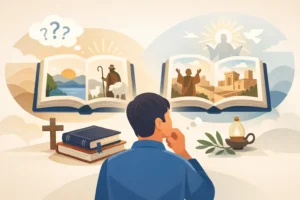
The Bible can feel like a library you entered through the wrong door. There are stories, poems, letters, laws, prophets, and visions, all written across many centuries. If you are asking which Bible books should beginners read first, you do not need to start at page one or understand everything at once. Start with books that show you who Jesus is, how God works, and what faithful living looks like.
A good beginner plan is not about checking off the most chapters. It is about building a clear foundation that helps you return tomorrow with confidence. Read slowly, keep a notebook nearby, and ask God to help you hear and obey His Word.
Which Bible Books Should Beginners Read First?
For most beginners, this order is a helpful place to begin: John, Genesis, Luke, Acts, Psalms, Proverbs, James, and Romans. You do not have to read every book straight through before moving to the next one. This path gives you the story of Jesus, the beginning of God’s plan, the life of the early church, prayers for real life, practical wisdom, and a clear explanation of grace.
If reading eight books feels like too much, begin with John, Psalms, and James. That small starting point can carry you a long way.
Start With the Gospel of John
John is often the best first Bible book for a new reader because it focuses clearly on Jesus. It shows His compassion, His conversations, His miracles, His death, and His resurrection. John does not merely tell you what Jesus did. It helps you see why Jesus came and invites you to trust Him.
As you read, pay attention to the seven signs Jesus performs and the statements where He says, “I am.” These passages reveal His identity as the Bread of Life, the Light of the World, the Good Shepherd, and the Resurrection and the Life.
Try reading one chapter of John each day. Afterward, write down three simple answers: What does this passage show me about Jesus? What does it show me about people? What is one response God may be asking of me?
John is especially helpful for someone who is new to Christian faith or returning after time away. Begin here before getting lost in difficult questions about family lines, Old Testament laws, or prophetic timelines.
Read Genesis to See the Beginning of God’s Story
After meeting Jesus in John, read Genesis. This first book of the Bible explains where the world came from, why sin has damaged it, and how God began His rescue plan through one family.
Genesis introduces major truths that appear throughout Scripture: God created people with purpose, sin brings separation and pain, God judges evil, and God keeps His promises. You will meet Abraham, Isaac, Jacob, and Joseph, whose stories help explain the promises fulfilled in Jesus.
Genesis also has challenging sections, particularly long family records and some difficult family situations. Do not let those stop you. Read the story sections carefully, and when you reach a passage you do not understand, mark it with a question and continue. You are learning the big story first, not taking a final exam.
For a shorter first pass, read Genesis 1-12, 15, 17, 22, 28, 32, 37-50. Then return later to fill in what you skipped.
Follow Jesus’ Ministry in Luke
John gives a close, faith-centered picture of Jesus. Luke gives a detailed, orderly account of His life and teaching. It pays special attention to people others often overlooked: children, the poor, the sick, women, outsiders, and sinners who turned back to God.
Luke is a wise next step because it includes many well-known parables, including the Good Samaritan, the Prodigal Son, and the Pharisee and the Tax Collector. These stories are memorable enough for family devotion, youth lessons, or small-group discussion, yet they continue to challenge mature believers too.
Read Luke with this question in mind: How does Jesus treat people? His words and actions show both truth and mercy. That pattern is deeply practical for everyday relationships.
Continue With Acts for the Story of the Early Church
Acts picks up where Luke ends. After Jesus rises and returns to heaven, the Holy Spirit empowers His followers to share the gospel. You will see the church begin in Jerusalem and spread into the wider world.
This book helps beginners understand that Christianity is not only about private belief. Jesus forms a people who pray, learn, serve, give, encourage one another, and tell others about Him. Acts also introduces Peter, Stephen, Philip, Paul, and other early believers whose lives show courageous faith in hard circumstances.
Not every event in Acts is meant to be copied in exactly the same way today. It is a historical account of the church’s beginning, not a step-by-step rulebook for every church practice. Still, its central message is clear: the risen Jesus continues His work through His people by the power of the Holy Spirit.
Keep Psalms and Proverbs Open Along the Way
You do not need to wait until you finish the Gospels to read Psalms and Proverbs. These books work well alongside any reading plan.
Psalms gives words for prayer when your own words feel small. Some psalms celebrate God’s goodness. Others cry out in fear, grief, confusion, or repentance. That honesty is a gift. You do not have to pretend before God. Read one psalm when you need comfort, help, or a reminder of God’s character.
Proverbs offers brief wisdom for daily decisions: speech, friendships, work, money, discipline, pride, and wise choices. Because there are 31 chapters, many people read one chapter a day for a month. Remember that proverbs are wise general principles, not guarantees that every situation will unfold the same way. They teach the path of wisdom, not a formula for controlling life.
Read James for Everyday Christian Living
James is short, direct, and wonderfully practical. It speaks about persevering through trials, listening before speaking, caring for people in need, controlling the tongue, resisting favoritism, and living with humble faith.
For beginners, James answers a common question: What does faith look like on an ordinary Tuesday? It looks like doing what God says, not simply agreeing with it. The book can feel challenging because its teaching is so direct, but receive that challenge as loving guidance.
James should be read alongside the Gospels, not as a replacement for them. Jesus is the center of the Christian faith. James helps believers put Jesus’ teaching into action.
Add Romans When You Want a Clearer View of Grace
Romans is one of the Bible’s most important explanations of the gospel. Paul writes about sin, grace, faith, salvation, the work of Christ, and the new life God gives His people.
It is also denser than John or James. That is why Romans is usually better after you have spent time in a Gospel and have seen the Bible’s larger story begin to take shape. Read it in small portions. A chapter a day is fine, but half a chapter is fine too.
When you come to a difficult paragraph, do not panic or quit. Read the surrounding verses, write down your question, and talk about it with a trusted pastor, mature Christian friend, or Bible study group. Growing in Scripture includes learning how to wait patiently for understanding.
A Simple 30-Day Beginner Bible Reading Plan
If you need a structured starting point, read John 1-21 over the first 21 days. On days 22-25, read Psalms 1, 23, 27, and 139. On days 26-30, read James 1-5.
This plan is short enough to complete and rich enough to establish a habit. When you finish, continue with Genesis, Luke, and Acts. If you miss a day, do not restart the plan or carry guilt into your next reading time. Simply pick up where you left off.
How to Read Without Feeling Overwhelmed
Choose a consistent time and a realistic amount. Ten focused minutes are more helpful than an ambitious plan you abandon after three days. Many people find it helpful to read a chapter, underline one meaningful verse, and write a one-sentence prayer in response.
Use a translation you can understand clearly. You may prefer the New Living Translation, New International Version, Christian Standard Bible, or English Standard Version. The best choice is often the one you will actually read regularly. If possible, compare a difficult verse in two translations, but avoid letting translation choices become a reason to delay reading.
Reading with others can also strengthen the habit. Parents can choose one short passage for family discussion. Small-group leaders can ask everyone to share one observation and one application. Youth leaders can focus on a Gospel story and invite honest questions. Scripture grows clearer when believers learn together.
You do not have to know the whole Bible before God can speak to you through it. Open John, read one chapter, and ask the Lord to show you Jesus. The next faithful step is enough for today.